Skip to content

Not every job needs an AI agent. Most need less.

We help companies choose the simplest automation that is reliable enough, and build it, with AI where it earns its place.

Talk to usHow we decide

Fixed rules same input, same result

Agent same input, results vary

  • How messy is the input?
  • How repeatable must the result be?
  • What does a wrong result cost?

Your answers tell you how much machinery the job needs. Often it is less than you expect.

Answer them for your job →

Start with the simplest thing that is reliable enough.

Describe your job with the sliders and we mark the approach that fits. Or browse them all: each one trades flexibility against repeatability, and costs differently to build, to run and to check.

Always the same formatFree text, mail, PDFs

Mostly structured, some free text

Some variation is fineIdentical every time

Mostly the same

Cheap to fixExpensive or harmful

Costs time or money

Fixed rules

A script, a scheduled job, an integration between two tools.

Use when
The input is predictable and the answer is always the same.
The trade
Cheapest to build, run and check. Same input, same result.
Build complexity
1 of 4
Running cost
1 of 4
Effort to check
1 of 4
Repeatable
4 of 4
Flexible
1 of 4

Rules plus AI for one step

AI reads or sorts the messy part. Fixed rules do everything else.

Use when
The input is messy (mail, PDFs, free text) but the outcomes are a fixed set of choices.
The trade
A small AI cost per run. The rules around it catch wrong guesses.
Build complexity
2 of 4
Running cost
2 of 4
Effort to check
2 of 4
Repeatable
3 of 4
Flexible
2 of 4

AI workflow with a checkpoint

AI drafts or decides inside limits you set. A person approves what matters.

Use when
The job needs judgment and a mistake is costly.
The trade
More flexible. Someone reviews every important result, and results vary.
Build complexity
3 of 4
Running cost
3 of 4
Effort to check
3 of 4
Repeatable
2 of 4
Flexible
3 of 4

Agent

AI chooses its own steps and tools, with few limits.

Use when
The task is open-ended, variation is fine and mistakes are cheap.
The trade
Most flexible, least repeatable. Costs a lot to run, and every result needs checking.
Build complexity
3 of 4
Running cost
4 of 4
Effort to check
4 of 4
Repeatable
1 of 4
Flexible
4 of 4

Agent with a harness and guardrails

An agent working inside limits: approved tools, budgets, automatic checks, logs, and a person signing off risky steps.

Use when
The task is open-ended and a mistake matters.
The trade
Dependable enough to trust, never identical. The most to build, and it keeps costing to run and to review.
Build complexity
4 of 4
Running cost
4 of 4
Effort to check
3 of 4
Repeatable
2 of 4
Flexible
4 of 4

What we do

Spot opportunities

We look at how your work really runs and spot where automation brings value. Every candidate gets a business case, because not every automation makes sense.

Train your team

Workshops on what is possible today, how to spot automation use cases in your own work, and how to build the simple ones yourselves.

Build and support

We support your team, or build the larger automations ourselves.

Change management

A tool only pays off when people use it. We support you with change-management best practices, so the value is actually earned.

How it starts: tell us about one process. We reply with which approach we think fits, or why it is not worth automating.

Talk to us

Built with AI. Runs without it.

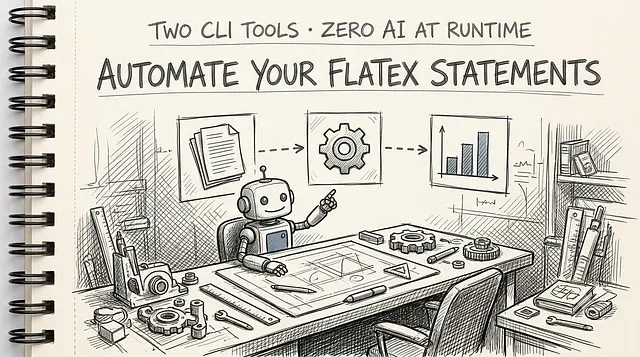
A banking automation we wrote up: AI helped build it, but it never calls a model at runtime, on purpose. The right tool, not the newest one.

More automations we have written up →Apps and games we build →

I Built a Banking Automation Tool Without Writing a Line of Go

Claude Code wrote it in a weekend. It never calls a model at runtime, on purpose.

Werner Liemberger · Aug 3, 2026

Focus on what matters. Automate the rest.

Which approach does your job need? Tell us about one process. We will tell you honestly what it needs, what it would take, or that it is not worth automating.

Talk to us